Why Smart Lighting is Revolutionizing the Modern Bedroom
Smart Bedroom Lighting Planner Ideas – Before diving into specific planning ideas, it’s crucial to understand why smart lighting has become an essential element of modern interior design, particularly for the bedroom. The benefits extend far beyond the novelty of changing a light’s color with your phone.
The core advantage is personalization. Traditional lighting offers a binary choice: on or off, and perhaps a simple dimmer. Smart lighting, however, provides a full spectrum of control. You can adjust brightness, change color temperature from a cool, energizing white to a warm, relaxing amber, and select from millions of colors to perfectly match your mood or decor.
This technology also introduces automation and convenience. Imagine your lights gradually brightening to mimic a sunrise, gently waking you up without a jarring alarm. Picture lights automatically turning on to a dim, warm glow when you get up in the middle of the night. This level of responsiveness transforms the bedroom into a space that actively works to make your life easier and more comfortable.
Finally, smart lighting is a cornerstone of wellness-focused design. By synchronizing your lights with your body’s natural circadian rhythm, you can promote better sleep, improve your mood, and boost your daytime focus. It’s an investment not just in your home’s technology, but in your personal well-being.

The Foundation of Your Smart Bedroom Lighting Plan: Layering
The most effective and visually appealing lighting designs are built on a simple principle: layering. This involves using multiple light sources to fulfill different functions, creating a space that is both practical and full of depth. Integrating smart technology into each layer is fundamental to achieving the best smart bedroom lighting planner ideas.
Ambient Lighting: The General Glow
Ambient lighting is the primary source of illumination in your room. It provides a comfortable, general level of brightness that allows you to see and move around safely. This is your foundational layer.
In a smart bedroom, traditional ceiling fixtures are replaced with intelligent alternatives. Consider a smart flush-mount ceiling light or a ceiling fan with an integrated smart light. For a more modern and seamless look, smart recessed downlights can be installed, allowing you to control groups of lights (or “zones”) independently for perfect, even coverage. The key is that this layer should be dimmable and, ideally, color-temperature tunable through an app or voice assistant.
Task Lighting: Focused and Functional
Task lighting is directed, focused light for specific activities. In the bedroom, this is crucial for tasks like reading, applying makeup, or working at a small desk. Without proper task lighting, you risk eye strain and frustration.
This is where smart lighting truly shines. A pair of smart bedside lamps can be set to the perfect brightness and color temperature for reading, controlled independently so one partner can read while the other rests. A smart light strip around a vanity mirror can provide clear, bright light for getting ready. For those with a desk in their bedroom, a dedicated smart desk lamp can be programmed to a cool, focus-enhancing white light during work hours.
Accent Lighting: Creating Drama and Interest
Accent lighting is the most creative layer. Its purpose is to draw attention to specific features in your room, such as a piece of artwork, a textured wall, or an architectural detail. It adds depth, creates contrast, and injects personality into the space.
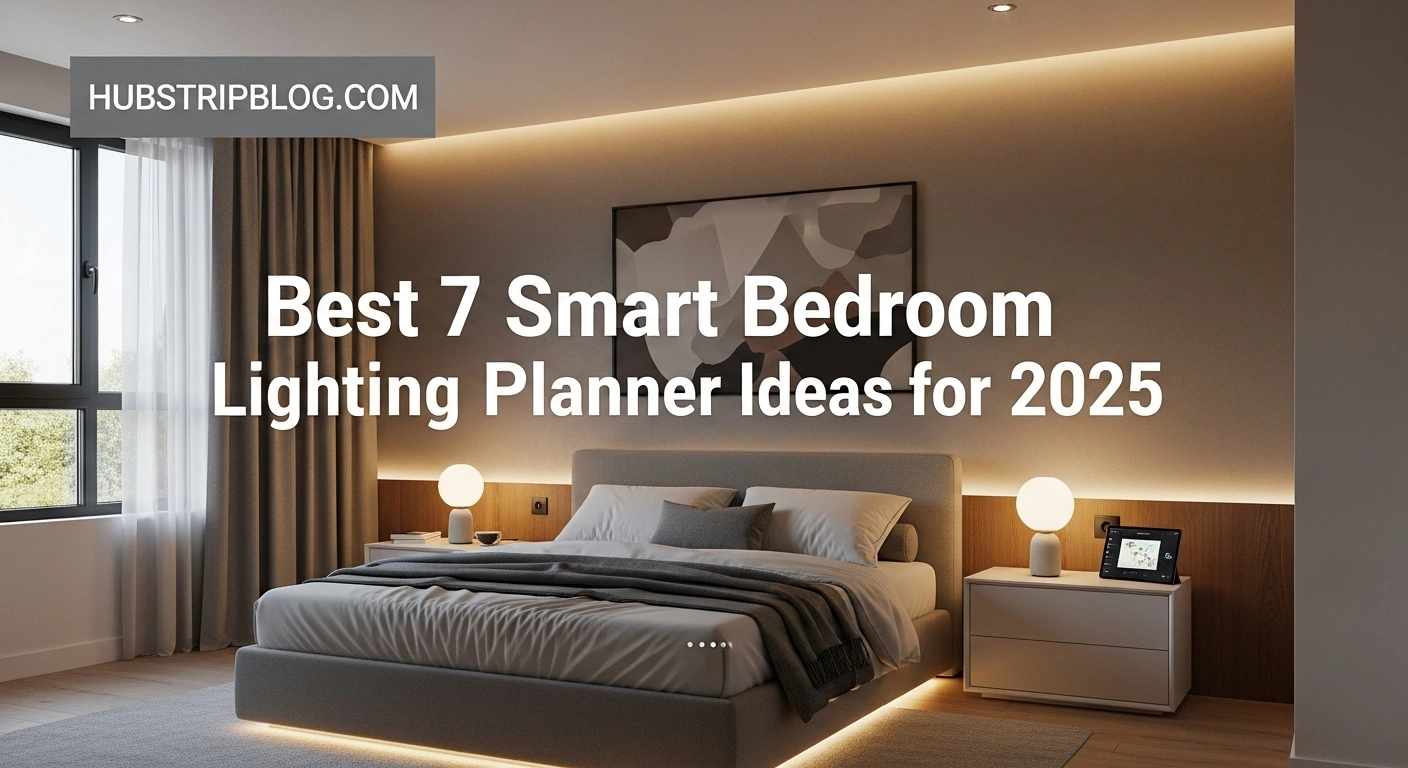
Smart accent lighting offers a world of possibilities. An RGBW (Red, Green, Blue, White) LED light strip mounted behind your headboard can create a stunning “floating” effect and wash the wall with any color you choose. A smart spotlight can be aimed at a favorite painting, with its brightness and color adjusted to complement the art perfectly. These elements are what elevate a good lighting plan into a great one.
The 7 Best Smart Bedroom Lighting Planner Ideas for 2025
With the foundational layers understood, we can now explore the innovative strategies and concepts that define the best smart bedroom lighting planner ideas for 2025. These ideas leverage the full potential of smart technology to create a truly next-generation bedroom experience.
1. The Human-Centric Circadian Rhythm Schedule
This is arguably the most impactful smart lighting strategy for your well-being. Circadian rhythm lighting, also known as human-centric lighting, involves programming your lights to mimic the natural progression of sunlight throughout the day. This helps regulate your body’s internal clock, leading to better sleep and improved daytime alertness.
How to Implement It
The key to this setup is using tunable white smart bulbs. These bulbs can transition smoothly from a bright, cool white (similar to midday sun) to a very soft, warm amber (like a sunset or candlelight).
Your daily schedule would look something like this:
- Morning (7:00 AM): Lights slowly fade on, starting with a warm glow and gradually shifting to a bright, cool-toned white over 30 minutes to energize you for the day.
- Daytime (9:00 AM – 5:00 PM): Lights remain at a neutral to cool white to promote focus and productivity, especially if you work from home.
- Evening (7:00 PM): Lights automatically shift to a warmer, softer tone, signaling to your brain that it’s time to start winding down.
- Bedtime (10:00 PM): The lighting dims to a very low, warm amber glow, minimizing the emission of blue light which can disrupt melatonin production.
Platforms like Philips Hue, Lutron Caseta, and even native systems like Apple HomeKit’s Adaptive Lighting can automate this entire process for you, making it a seamless part of your daily routine.
Why It’s a Top Idea for 2025
Health and wellness are no longer afterthoughts in home design; they are central. As our understanding of the profound effect of light on our biology grows, integrating circadian rhythms into our homes will become standard. This planner idea moves beyond aesthetics and turns your bedroom lighting into a proactive tool for better health.
2. Zoned Automation with Voice and Motion Control
A truly smart bedroom is one that anticipates your needs. By dividing your bedroom into functional zones and assigning specific automated behaviors to each, you create an environment of unparalleled convenience.
Imagine your bedroom divided into four zones:
- The Bed Area: Lights here are focused on relaxation and reading.
- The Closet/Dressing Area: This zone requires bright, clear light.
- The Pathway: The path from your bed to the door or bathroom.
- The Reading Nook: A dedicated corner with specific task lighting.
You can then apply automation triggers. A smart motion sensor placed under the bed can be programmed to activate only between 10 PM and 6 AM. When it detects motion (you getting up for a glass of water), it turns on a light strip under the bed frame to just 10% brightness in a warm color, illuminating the floor without blinding you or disturbing your partner.
Voice control adds another layer of precision. Instead of a general command like “turn on the lights,” you can be specific:
- “Hey Google, turn on the closet light to 100%.”
- “Alexa, set the reading light to warm white.”
- “Siri, activate ‘Movie Mode’,” which could dim all lights except for a soft accent light behind the TV.
This level of granular, zone-based control is a hallmark of an advanced smart lighting plan. It’s about making the technology feel intuitive and invisible.
3. Integrated Entertainment and Ambiance Syncing
As bedrooms increasingly double as personal entertainment spaces, your lighting can be used to create a more immersive experience. This involves syncing your smart lights with the content on your screen or the music you’re playing.
To achieve this, you’ll need specific hardware and software. The Philips Hue Play HDMI Sync Box is a popular choice. It sits between your media devices (like an Apple TV, PlayStation 5, or Blu-ray player) and your TV. It reads the HDMI signal in real-time and instructs your connected Hue color lights to match the colors on the screen, extending the visual experience beyond the TV’s borders.
For PC gamers, software from brands like Nanoleaf and Corsair can sync on-screen action with light panels and strips, creating a truly dynamic gaming battle station within the bedroom. For music lovers, many smart lighting apps have features that use your phone’s microphone to pulse the lights to the beat of the music, instantly turning your room into a private lounge.
This idea transforms a passive viewing or listening experience into an active, multi-sensory one, making it one of the most exciting and forward-looking best smart bedroom lighting planner ideas.

4. Architectural Highlighting with Smart LED Strips
Smart LED strips are one of the most versatile tools in a lighting planner’s arsenal. They are no longer just for novelty “gamer” setups. In 2025, they are being used with sophistication to create high-end, architectural effects that were once the domain of custom, expensive installations.
Consider these applications:
- Cove Lighting: Place a hidden LED strip in a ceiling cove or recess. This creates a beautiful, soft, indirect ambient light that washes across the ceiling, making the room feel larger and more open.
- Under-Bed Lighting: As mentioned with motion sensors, a strip under the bed frame provides a practical night light and a stunning “floating bed” visual effect.
- Headboard Backlighting: This is perhaps the most popular application. It creates a focal point in the room, serves as a low-level reading light, and adds a layer of soft, indirect accent light.
- Closet Interior Lighting: Line the inside of your closet with a smart light strip connected to a door sensor. The moment you open the door, the closet is perfectly illuminated.
The flexibility and low profile of these strips allow them to be placed almost anywhere, offering a way to add a layer of luxurious, integrated light that dramatically enhances the room’s architecture.
5. The Ultimate “Wind-Down” and “Wake-Up” Scene
This idea takes automation a step further by creating “scenes” or “routines” that control multiple smart devices simultaneously with a single trigger. This is about creating holistic environmental shifts that support your transition into and out of sleep.
A “Wind-Down” Scene, which you could activate by saying “Hey Siri, it’s time to relax,” might trigger the following sequence:
- All overhead ambient lights turn off.
- Bedside lamps dim to a warm 20% brightness.
- The accent light behind the headboard shifts to a calming deep blue or soft lavender.
- If you have smart blinds, they lower.
- A smart speaker begins playing a “sleep” playlist or white noise.
Conversely, a “Gentle Wake-Up” Scene, scheduled for your desired wake-up time, could do this:
- At 6:30 AM, the lights begin to slowly fade on, mimicking a sunrise.
- At 6:45 AM, the smart blinds slowly begin to rise.
- At 7:00 AM, the lights reach a bright, energizing white, and your smart speaker provides a weather and news briefing.
These multi-device routines are the pinnacle of smart home automation. They reduce the mental load of nightly and morning tasks and create consistent, supportive rituals that improve your quality of life. The increasing power of platforms like Amazon Alexa Routines, Google Home Automations, and Apple’s Home app makes creating these complex scenes easier than ever.
6. The Hybrid Approach: Smart Switches and Dimmers
One of the biggest frustrations with early smart bulbs was that they became “dumb” the moment someone instinctively flipped the wall switch off. The hybrid approach solves this problem by upgrading the wall switch itself, creating a system that is both intelligent and intuitive for everyone.
Smart switches and dimmers replace your existing wall switches. They remain powered and connected to your network at all times, ensuring your smart bulbs are always ready for commands. This provides the best of both worlds:
- App & Voice Control: You retain the ability to control color, brightness, and scenes from your phone or smart speaker.
- Physical Control: Anyone in the room, including guests or children, can use the familiar wall switch to turn lights on, off, or dim them without breaking the smart home automations.
Looking towards 2025, the rise of the Matter smart home standard will make this even more seamless. Matter allows devices from different brands (like a Lutron switch and a Philips bulb) to communicate directly with each other without needing complex workarounds. Investing in smart switches is a future-proof strategy that ensures your lighting system is robust, reliable, and user-friendly.

7. Sustainable and Energy-Efficient Planning
The final planner idea focuses on sustainability. Smart lighting is inherently more efficient than traditional lighting because it uses LED technology, which consumes significantly less power. However, the “smart” aspect provides additional layers of energy savings.
Your smart lighting plan should include strategies for minimizing energy waste:
- Presence Detection: Use motion sensors not only to turn lights on but, more importantly, to turn them off. A sensor in the bedroom can automatically turn off all lights after it detects no motion for 15 minutes.
- Daylight Harvesting: If you have large windows, a smart ambient light sensor can detect the amount of natural light in the room. It can then automatically dim your smart bulbs to maintain a consistent level of light, using only as much artificial light as is absolutely necessary.
- Energy Monitoring: Many smart lighting apps, such as those from TP-Link Kasa and Philips Hue, provide dashboards that show you exactly how much energy your lights are consuming. You can use this data to identify inefficiencies and fine-tune your automation schedules.
By consciously building these energy-saving automations into your plan, your smart lighting system becomes not only a tool for comfort and wellness but also a responsible choice for the environment and your electricity bill.
Choosing the Right Smart Lighting Ecosystem
A crucial part of your planning process is selecting the ecosystem that will power your smart bedroom. This decision will influence the products you can use and how they work together.
- Platform-Based (Hub Required): Systems like Philips Hue and Lutron Caseta use a central hub that connects to your router. This creates a dedicated, reliable network (like Zigbee) for your lights, which is often faster and less prone to Wi-Fi congestion. These systems are known for their premium quality, extensive features, and broad compatibility.
- Wi-Fi-Based (Hubless): Brands like Wyze, Sengled, and TP-Link Kasa offer smart bulbs and devices that connect directly to your home’s Wi-Fi network. They are typically more affordable and easier to set up, making them a great entry point. The main drawback is that having too many devices can potentially slow down your Wi-Fi network.
- The Future: Matter. As mentioned, Matter is a unifying smart home standard backed by Apple, Google, Amazon, and others. When you buy a Matter-certified device, you can be confident it will work with any Matter-compatible controller (like a smartphone or smart speaker), regardless of the brand. As we move into 2025, prioritizing Matter-compatible gear is the smartest way to ensure long-term interoperability.
Conclusion
Designing your bedroom’s lighting for 2025 is about more than just choosing nice fixtures. It’s about creating a responsive, personalized, and health-conscious environment. The journey begins with a solid understanding of the principles of layering—ambient, task, and accent lighting—and then elevating each layer with intelligent, purposeful technology.
By embracing these best smart bedroom lighting planner ideas, from human-centric circadian schedules to immersive entertainment syncing, you can transform your bedroom from a static space into a dynamic sanctuary. The focus is on creating a seamless system that enhances your well-being, simplifies your routines, and provides moments of delight and comfort. The perfect smart bedroom is not just illuminated; it’s intelligent, intuitive, and in tune with you.