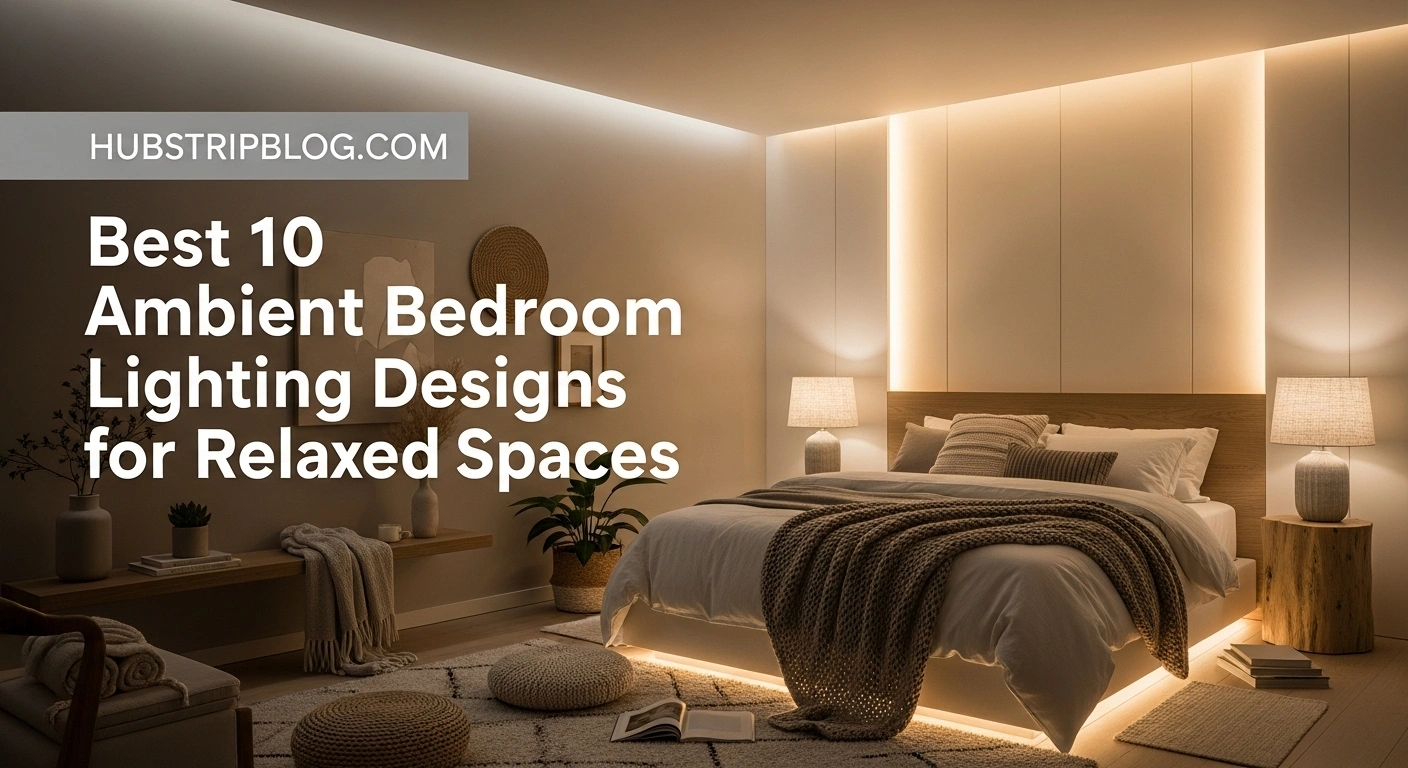
The Foundation of a Relaxing Atmosphere: What Is Ambient Lighting?
Ambient Bedroom Lighting Designs – Before diving into specific designs, it’s crucial to understand the role of ambient lighting. In lighting design, professionals often speak of three layers: ambient, task, and accent. Ambient lighting, also known as general lighting, is the foundational layer. It provides overall, uniform illumination for a room, allowing you to navigate the space safely and comfortably.
Unlike harsh, direct light, true ambient lighting is soft, diffuse, and creates very few shadows. It sets the primary mood of the bedroom. Think of the gentle glow of a sunset or the soft light on an overcast day—this is the feeling ambient lighting aims to replicate indoors. Achieving this is the first and most critical step in any effective lighting plan.

The Core Principles: Planning Your Ambient Lighting Scheme
Creating a perfect lighting scheme doesn’t happen by accident. It requires thoughtful consideration and planning. The best ambient bedroom lighting planner designs are born from a strategy that considers the room’s architecture, your personal habits, and the specific mood you wish to cultivate.
Assessing Your Bedroom’s Unique Canvas
Every bedroom tells a different story — and before you even think about adding a single light fixture, it’s essential to truly understand the canvas you’re working with. Start by taking a quiet moment to observe your space. Notice how the light moves throughout the day, how shadows fall, and where your eyes naturally go when you walk into the room. These subtle details will guide every lighting decision that follows.
Room dimensions and proportions play a major role in shaping your lighting strategy. A bedroom with high, vaulted ceilings, for example, offers the perfect opportunity for a dramatic chandelier or a cluster of pendant lights that draw the eye upward, emphasizing vertical space. On the other hand, if your bedroom has a low ceiling, consider sleek flush mounts, semi-flush fixtures, or recessed lighting — designs that provide illumination without visually crowding the room.
Natural light is equally important. A bedroom bathed in morning sunlight might only need soft, ambient lighting for the evenings, while a darker, north-facing room could benefit from layered lighting — combining ceiling fixtures, bedside lamps, and even under-bed or cove lighting to create warmth and depth.
Then, turn your attention to furniture placement. Where your bed sits determines more than just sight lines — it affects where your lighting should fall. Do you have a reading nook with an armchair that deserves its own floor lamp? A vanity or dresser where you’ll want bright, focused illumination? Perhaps an artwork or accent wall that could come alive under a soft directional light? Each zone of your bedroom serves a purpose, and your lighting should enhance, not compete with, those functions.
Finally, think about how you use your bedroom beyond sleeping. Is it a retreat for unwinding with a book? A workspace? A space for reflection or romance? The answers will dictate the tone of your lighting — whether you lean toward cool, crisp brightness or warm, inviting glows that soothe the senses.
In essence, lighting isn’t about filling a room with bulbs — it’s about sculpting emotion through light. Once you understand your bedroom’s proportions, layout, and personality, every fixture you choose becomes intentional — a brushstroke that contributes to a perfectly balanced composition.
The Psychology of Light: Choosing the Right Color Temperature
Light doesn’t just illuminate a room — it shapes how we feel within it. The subtle hue of your lighting can shift your entire emotional landscape, influencing energy, focus, and even how well you sleep. That’s why understanding the psychology of color temperature isn’t merely a design choice — it’s a key to crafting the mood and function of your bedroom.
Measured in Kelvin (K), color temperature describes the “warmth” or “coolness” of light. At the higher end of the spectrum (around 5000K and above), light takes on a crisp, blue-white tone — similar to bright daylight or office lighting. This type of illumination stimulates alertness and enhances concentration, making it perfect for workspaces or bathrooms where precision is needed. But in a bedroom, this kind of light can feel harsh, sterile, and counterproductive to relaxation — almost like trying to fall asleep under fluorescent lights.
In contrast, warm lighting — typically ranging between 2700K and 3000K — bathes a room in a soft, golden glow reminiscent of candlelight or a sunset. This gentle radiance signals to your brain that it’s time to unwind. Scientifically, warm light encourages the body’s natural production of melatonin, the hormone that regulates sleep cycles. Psychologically, it evokes comfort, safety, and intimacy — exactly what you want to feel as you settle into bed.
Designers often describe warm lighting as the visual equivalent of a cozy blanket — wrapping the room in softness and tranquility. It flatters skin tones, enhances textures, and deepens the sense of calm. Cool light, on the other hand, emphasizes contrast and clarity — energizing, but better suited for mornings or task-specific zones like dressing areas or reading nooks.
A balanced lighting plan might incorporate both, using layered illumination to transition smoothly from daytime brightness to evening serenity. For example, a dimmable ceiling light could provide crisp light in the morning, while bedside lamps or sconces cast a warm glow at night.
Ultimately, choosing the right color temperature isn’t just about aesthetics — it’s about aligning your environment with your body’s natural rhythms. By tuning your lighting to support rest and relaxation, you transform your bedroom from a functional space into a true sanctuary of well-being.
The Non-Negotiable Element: Dimmers
If there’s one feature that separates a well-lit bedroom from a truly masterful one, it’s the dimmer switch. Think of it as the conductor of your lighting orchestra — seamlessly transitioning your space from energetic mornings to serene nights. Dimmers aren’t just a luxury; they’re an absolute essential for anyone who wants their bedroom lighting to adapt to the rhythm of real life.
The beauty of a dimmer lies in its simplicity. With a single touch or twist, you gain complete control over brightness and mood. When you’re getting dressed or organizing your wardrobe, full illumination helps you see every detail clearly. But as evening settles in, lowering the lights instantly transforms the room. The atmosphere shifts — shadows lengthen, textures deepen, and the harshness of daylight gives way to a soft, golden calm that invites you to unwind.
This ability to modulate intensity is what elevates any bedroom lighting design from merely functional to emotionally intelligent. It allows your lighting to respond intuitively to different activities — from reading in bed to sharing a quiet conversation or simply taking a few moments to breathe before sleep. Designers often say that dimmers are the “volume controls” of interior light, and the analogy couldn’t be more apt.
Pair dimmers with layered lighting — ceiling fixtures, bedside sconces, floor lamps — and you unlock a world of flexibility. Imagine the overhead pendant softly glowing at 40%, wall sconces radiating warmth at 60%, and a bedside lamp turned low enough to make the room feel cocooned. This harmony of gradients is what defines the best ambient bedroom lighting planner designs — refined, versatile, and deeply human in their responsiveness.
Beyond aesthetics, dimmers also extend the life of your bulbs and conserve energy, a subtle nod to sustainability without compromising luxury. Whether your fixtures are classic incandescents, sleek LEDs, or smart-enabled systems, nearly every modern lighting setup can incorporate dimming functionality.
In the end, a bedroom without dimmers is like a piano that only plays one note — capable, but limited. The ability to fine-tune your light’s intensity transforms your bedroom from a static environment into a living, breathing sanctuary that evolves with every moment of your day.
The Top 10 Ambient Bedroom Lighting Designs for a Relaxed Space
Now, let’s explore the ten best design approaches to achieve that perfect ambient glow. These ideas range from timeless classics to modern innovations, offering options for every style and budget.

1. The Timeless Centerpiece: Chandeliers and Flush Mounts
A central overhead fixture is the most common source of ambient light. However, the choice of fixture makes all the difference.
For Dramatic Flair: The Chandelier
A chandelier can serve as a stunning focal point while providing widespread, diffused light. In a master bedroom with high ceilings, a chandelier adds a touch of luxury and elegance. Choose a design with multiple bulbs and fabric shades or frosted glass to soften the light and prevent glare. Modern sputnik designs or rustic beaded chandeliers can work just as well as traditional crystal ones.
For Understated Function: The Flush or Semi-Flush Mount
In rooms with standard or low ceilings (8 feet or less), a flush mount or semi-flush mount fixture is the ideal choice. These fixtures sit close to the ceiling, preventing them from overwhelming the space. Look for designs with a fabric drum shade or a frosted glass diffuser. This ensures the light is scattered evenly throughout the room, creating a soft, shadow-free ambiance.
2. The Architectural Glow: Cove Lighting
Cove lighting is one of the most elegant and effective methods for creating ambient light. This technique involves placing light sources—typically LED strips—inside a ledge, recess, or high on the walls. The light is directed upward, bouncing off the ceiling and washing back down into the room.
This indirect illumination is exceptionally soft and completely glare-free. It creates a “floating ceiling” effect that can make a room feel larger and more open. Cove lighting is a cornerstone of minimalist and contemporary best ambient bedroom lighting planner designs, providing a seamless, built-in look that feels incredibly luxurious.
3. The Minimalist Approach: Thoughtfully Placed Recessed Lighting
Recessed lights, or pot lights, have a reputation for creating a sterile, “runway” look. However, when used strategically, they can be an excellent source of ambient light. The key is to avoid placing them in a rigid grid pattern in the center of the room.
Instead, use them as wall washers. Place a few recessed lights near the perimeter of the room and aim them at the walls. This technique highlights the texture of your walls, makes the room feel wider, and provides beautiful, indirect ambient light. Always, always install them with a dimmer switch.
4. The Directed Ambiance: Modern Track Lighting
Track lighting isn’t just for art galleries and kitchens. Modern systems have become incredibly sleek and versatile, offering a fantastic solution for bedrooms, especially those with unusual shapes or concrete ceilings where recessed lighting isn’t an option.
The main advantage of track lighting is its flexibility. You can aim each head individually. Don’t point them down into the room. Instead, direct the heads towards walls, curtains, or the ceiling. By bouncing the light off these surfaces, you transform a potentially harsh source into a soft, ambient layer.
5. The Layered Foundation: Table and Floor Lamps
While often considered task lighting, a collection of well-placed lamps can collectively serve as the primary source of ambient light. This approach creates a cozy, intimate, and highly customizable environment.
Place a couple of table lamps on nightstands or dressers and a floor lamp in a corner. The key is to choose lamps with shades that diffuse light well. Fabric, paper, or frosted glass shades are excellent choices. By turning on all of them at once (perhaps controlled by a single smart plug), you create multiple pools of soft light that merge into a room-filling glow.
6. The Framed Glow: Wall Sconces
Wall sconces are a fantastic way to add a layer of ambient light while also contributing to the room’s decor. They are particularly effective when installed in pairs, such as on either side of the bed or framing a large mirror or piece of art.
For maximum ambient effect, choose sconces that direct light both upwards and downwards, or those with a heavy diffuser that casts a soft all-around glow. This not only illuminates the space but also adds architectural interest and a sense of symmetry and balance, which are key components of relaxing design.
7. The Ethereal Halo: Backlit Headboards and Panels
For a truly modern and high-impact look, consider creating a backlit headboard. This is typically achieved by installing LED strip lighting behind an oversized or floating headboard. The result is a stunning halo of soft, indirect light that frames the bed, the focal point of the room.
This technique provides a perfect low-level ambient glow for winding down in the evening. It feels deeply integrated into the architecture of the room, making it a favorite in sophisticated, contemporary best ambient bedroom lighting planner designs. The same principle can be applied to decorative wall panels or large-scale art.
8. The Whimsical Charm: String Lights
Often associated with dorm rooms or patios, string lights (or fairy lights) can be used in a surprisingly sophisticated way to create a dreamy, magical ambiance. The key is to use warm white lights and to be intentional with their placement.
Drape them behind a sheer canopy over the bed, cluster them inside a large glass cloche on a dresser, or carefully arrange them around a large floor mirror. Their tiny points of light are not overwhelming but combine to produce a gentle, sparkling ambient effect that is both playful and deeply relaxing.
9. The Suspended Statement: Pendant Lights
Pendant lights offer a stylish alternative to traditional bedside lamps. By hanging a pair of low-wattage pendants on either side of the bed, you free up valuable nightstand space and create a strong vertical design element.
Choose pendants with opaque or heavily diffused shades to ensure the light is soft and directed. When hung at the proper height, they provide enough light for reading but also contribute significantly to the room’s overall ambient light levels, adding a chic, hotel-inspired touch.

10. The Ultimate Control: Integrated Smart Lighting
The future of ambient lighting is smart. Systems like Philips Hue, LIFX, and others allow for unprecedented control over your bedroom’s atmosphere. Smart bulbs can be tuned to millions of colors and any shade of white, from cool and energizing to warm and sleepy.
You can create “scenes” for different activities—a “Relax” scene that dims the lights to a warm, 2700K glow, or a “Wake-Up” scene that slowly brightens the lights in the morning to mimic a natural sunrise. The ability to control your entire lighting scheme with your voice or an app is the final word in creating a responsive, personalized, and truly relaxing environment.
Putting It All Together: Your Ambient Lighting Action Plan
Now that you’re armed with ideas, it’s time to create a cohesive plan. The best ambient bedroom lighting planner designs are layered and intentional.
- Start with a Sketch: Draw a simple floor plan of your bedroom. Mark the location of the bed, windows, doors, and other major furniture.
- Choose Your Primary Ambient Source: Select one of the designs above to be your main source of general illumination. This could be a central flush mount, cove lighting, or strategically placed recessed lights. This is your foundation.
- Add Secondary Layers: Now, add at least two other sources of light. If you chose a flush mount, add a pair of bedside lamps and a floor lamp. If you chose cove lighting, perhaps add wall sconces to frame the bed. This layering is what creates depth and visual interest.
- Incorporate Dimmers and Smart Controls: Ensure your primary overhead source and any hardwired sconces are connected to dimmer switches. Consider using smart plugs for your lamps to integrate them into a single, controllable system.
- Select Warm Bulbs: For every single fixture in your bedroom, choose bulbs with a color temperature of 2700K to 3000K. Consistency is key to creating a unified, tranquil atmosphere.
Conclusion
Transforming your bedroom into a peaceful sanctuary is an achievable goal, and the journey begins with light. By moving beyond a single, functional fixture and embracing a layered, thoughtful approach, you can craft an environment that actively promotes rest and relaxation. The right lighting doesn’t just illuminate a room; it defines its soul.
From the architectural elegance of cove lighting to the modern magic of a smart system, the options are as varied as your personal style. By understanding the core principles of ambient light and carefully considering your space, you are no longer just choosing light fixtures—you are composing an experience. Ultimately, the quest for the best ambient bedroom lighting planner designs is a deeply personal one, aimed at creating a space that not only looks beautiful but feels like a true retreat from the outside world.